About us
Najio-washi and Futamata-washi, important friends of craftsmen well-versed in the production of high-quality gold leaf
"Hakuuchishi" is an indispensable element in the production of gold leaf.
Since its founding, Nakamura Seihakusho has been making hakuuchishi (foil-beating paper) using Najio-washi from Nishinomiya of Hyogo prefecture and Futamata-washi from Kanazawa. Najio-washi is a highly durable and robust traditional Japanese paper made primarily from the ganpi plant.
The ganpi plant has a glossy fiber that is fine and smooth, making it a common material for notebooks with Japanese-style bindings, goshuincho books, Japanese sliding screens, and shoji paper. Futamata-washi is made from the bark of "kozo," a hybrid mulberry tree, whose durability and lightweight nature make it suitable for use as art paper, hoshogami paper, and shoji paper, despite its high price. Hakuuchishi is made by soaking these washi in lye and persimmon juice, drying them, and working them over the course of around one month using expert techniques to achieve a uniform thickness. Although this is tedious work, this crucial step greatly affects the quality of the final product in the production of "high-quality gold leaf."
Bringing out the brilliance of gold through perseverance and advanced technology
The hakuuchishi is finally ready after several months.
During this time, a 3-mm-thick layer of the supernatant fluid is carefully applied to each sheet of paper, following which the foil is beaten repeatedly until it is flattened to a thickness of around 0.0001mm (equivalent to spreading gold around the size of a 10-yen coin across the area of 4 tatami mats). This process of beating the foil to spread it out uniformly takes a long time and requires the skills of an experienced craftsman.
Feel the pulse of the production process that creates delicate gold leaf so thin that it adheres to surfaces in an instant
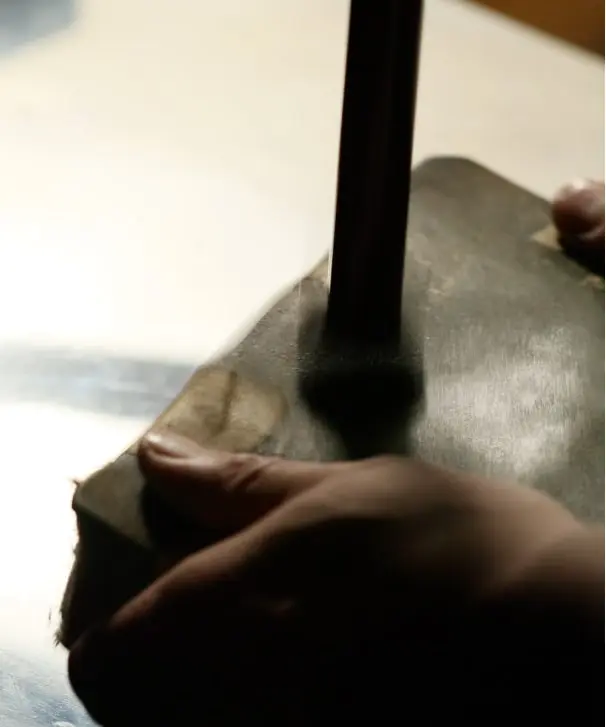
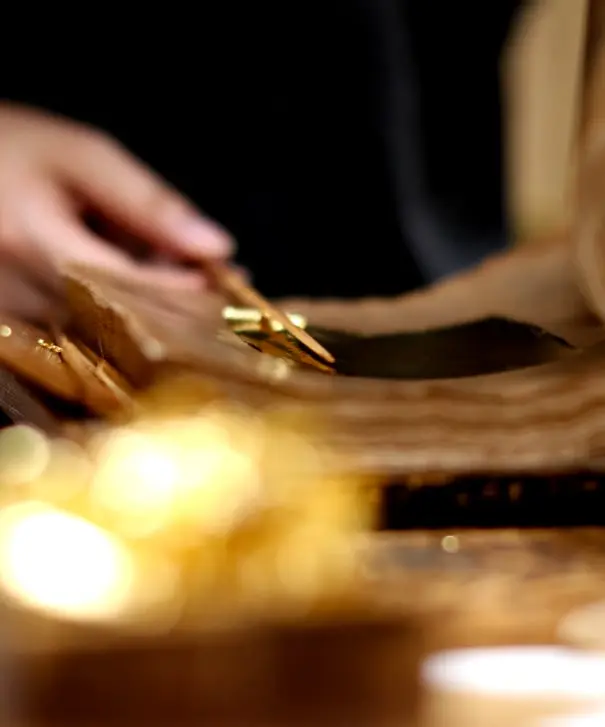
In the foil transfer step, special bamboo chopsticks are used to gently pick up the gold leaf from the foil-pressing book and transfer it to the leather board. With a small puff of air, the air currents between the leather board and the gold leaf gives rise to a ripple-like pattern. If the gold leaf comes into direct contact with a person's hand, the gold leaf will adhere to it in an instant and crumble into dust. Hence, the final step, too, requires someone with an experienced technique to complete successfully.
Greeting
Nakamura Seihaku Co., Ltd. was founded in 1935 (Showa 10) in Kanazawa by our predecessor, Toyokichi Nakamura, who began the craft and trade of gold leaf. To this day, we continue to uphold the traditional manufacturing methods unchanged, passing the craft down through four generations: from the second-generation Koichiro Nakamura, to the third-generation Kenryo Nakamura, and now to the fourth-generation Kentaro Nakamura, producing and dealing in Kanazawa-haku enzuke gold leaf.
Because gold leaf is extremely thin and delicate, its production requires exceptional craftsmanship and enduring patience. The Kanazawa gold leaf, created by artisans born and raised in the Hokuriku region, is delivered to the hands of fellow artisans, craftworkers, restorers, and artists, where it is reborn into new works and products. At Nakamura Seihaku Co., Ltd., we operate an integrated system covering everything from production to sales, enabling us to respond to a wide variety of needs. We can reproduce gold leaf from different historical periods, handle small-lot production, and propose the most suitable gold leaf tailored to the customer’s intended use. Please feel free to contact us with any inquiries.
President & CEO
Kenryo Nakamura
The Gold Leaf Artisan
Masters who preserve the timeless art of handcrafting gold leaf with precision and dedication.
Nurturing Paper into Fine Gold Leaf
Even the slightest change in the paper is captured, nurturing it into high-quality foil-beating paper. In gold leaf production, the experience and intuition of artisans are essential at every stage. In the foil-beating process, the quality of paper preparation determines the final outcome. Depending on the paper’s condition, adjustments are made—changing the beating spot, extending cooling time in hot weather, or adjusting steaming time when humidity is high. Even though the work may be the same, subtle changes occur with the seasons and weather, requiring careful fine-tuning. Through the repetition of daily work, artisans use both body and mind to read the character of each sheet of washi, and with care, craft foil-beating paper suited to it, one sheet at a time.
Kenryo.N
Crafting Gold Leaf with Care
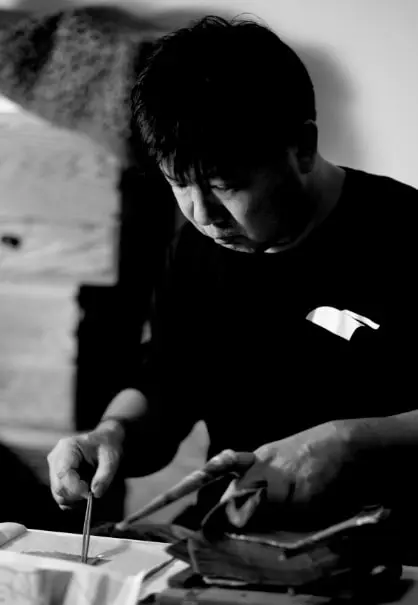
Making gold leaf takes an exceptionally long time. The work involves endlessly repeating similar tasks, making patience the most essential quality. That is why, when beating the foil, artisans focus completely on their work, keeping their emotions from affecting the delicate leaf. While many people associate “gold leaf” with Buddhist altars or ritual items, it is actually used in a wide variety of applications, including tableware, accessories, interior design, and beauty products. We hope more people will learn about these uses, and we aim to continue creating gold leaf that brings warmth and presence into everyday life.
Kentaro.N

The history of Kanazawa and gold leaf
The Hokuriku region has a climate and environment that is ideal for producing gold leaf,
and the traditional manufacturing methods have been passed down to the present day
by artisans in Kanazawa in a variety of traditional craft industries, including Kaga Yuzen, Wajima lacquerware, and Kutani ware .
The manufacturing process of a sumo craftsman
1. Gold matching
First, small amounts of silver and copper are added to the gold and poured into a mold. This mold is then heated to around 1,300 degrees to create an alloy. Pure gold (99.99%) is too soft to be suitable for making foil, so silver and copper are mixed in and melted. By changing the ratio of silver and copper, different shades of gold foil can be created.
2. Noben
The gold alloy is rolled into a strip and then cut into small pieces about 6 cm square, 0.3 mm thick.
3. Preparation of Sumiuchi paper
Washi paper from Futamata, Kanazawa is soaked in lye and turned into clear paper.
4. Clear sashimi
The gold is sandwiched between sheets of clear paper. This is beaten and stretched, and the stretched gold is cut into quarters, then transferred one sheet at a time and beaten and stretched again. The product that is created by repeating this process is called uwazumi.
5. Tailoring
The top layer is cut into 20cm squares and folded into thirds. The top layer, once prepared by the top layer craftsman, is then passed on to the gold leaf craftsman.
The manufacturing process of a foil craftsman
6. Preparation of the foil-beating paper
Kanazawa's Futamata washi paper is used as the base paper, and then it is finished into gold leaf paper. The quality of the paper produced here has a big impact on the quality of the gold leaf.
7. Pull-in and Uchimae
First, the top layer of the gold leaf is cut into 9 to 12 sheets, a process called "sumikiri." Next, the small pieces of top layer are sandwiched one by one between sheets of gold leaf paper (komaki paper), a process called "hikiire." The top and bottom of the stack of gold leaf paper (komaki paper) are then sandwiched between cowhide leather, and the gold leaf is beaten up in a gold leaf beating machine. The hot paper is then cooled and beaten again, and this process is repeated until the gold leaf is finished to a thickness of just 1/10,000 of a millimeter.
8. Pulling work
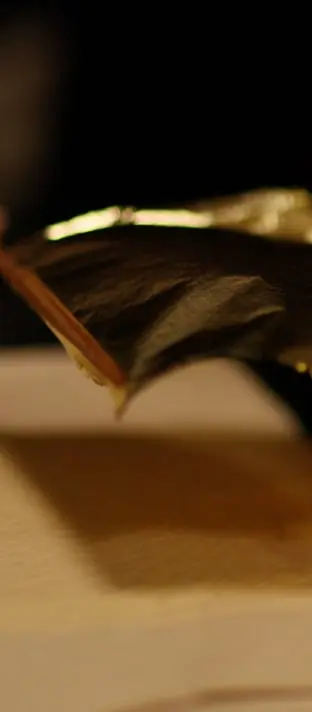
The finished gold leaf is selected based on its quality. Next, it is transferred from the gold leaf beating paper to a large book. The thin gold leaf is so delicate that it can be torn by breath, static electricity, or bare hands. For this reason, bamboo chopsticks and Tengu claws, which are less likely to generate static electricity, are used for the transfer process.
9. Foil transfer
The foil from the book is cut to the specified size and placed on the paper cutting. This is how the traditional Kanazawa foil (framed foil) is completed.

Various uses
Kanazawa gold leaf has long played a major role as an important material for decorating and restoring Japan's national treasures, important cultural properties, shrines, temples, and Buddhist altars. In recent years, in line with changes in modern lifestyles, it has come to be used in everyday items such as crafts, accessories, tableware, interior decor, and beauty cosmetics, and the inherited history and culture still lives on in the town of Kanazawa. Here we will introduce some of the fascinating and ever-changing world of Kanazawa gold leaf.
Materials for the restoration and restoration of national treasures, important cultural properties, shrines and temples
Nakamura Foil Co., Ltd. is engaged in the restoration and restoration of various cultural properties. As part of our cultural property preservation activities, we also undertake the restoration of gold leaf used in the Kamakura and Edo periods. If you let us know the alloy composition ratio of the time, we can recreate the gold leaf of that era. Please feel free to contact us if you have any concerns about the preservation or restoration of cultural properties.
Painting and craft materials
It can be used for Japanese paintings, paintings, crafts, and various other decorations. Please feel free to contact us if you have any questions about how to handle gold leaf (the difference between the front and back).
Beauty gold leaf
It can be used for various decorations such as beauty cosmetics, nails, hair styling products, etc. Recommended as a tailoring item for special occasions.
Building and decorative materials
It can be used for a variety of decorations, such as apartment entrance hall designs, monuments, store signs, and residential interiors such as glass tiles. It is recommended for creating an elegant and dazzling Japanese space.
Gold leaf for food
We offer only products that can be used with confidence, not just as items to brighten up your daily life, such as meals.